Getting to Dodger Stadium
The quick read
Plan the trip around one fact: this is the most car-centric park in Major League Baseball. It sits up in Chavez Ravine, just north of Downtown LA, with no rail line running to it and about 16,000 parking spaces wrapped around it in terraced lots. The drive in is fine. The crawl out after the game, when tens of thousands of cars try to leave at once, is the part that earns the park its reputation.
So here is the order we recommend. Rideshare first, because it skips the parking math and the lot crawl entirely. Then the free Dodger Stadium Express if you are near Union Station or one of the South Bay stops. Then driving and parking, which is what plenty of fans do anyway, especially groups, as long as you go in knowing about the exit.
One check beats all of this: drop “Dodger Stadium” into your maps app with your hotel as the start and switch to transit and rideshare directions. It will give you the real time and cost from your exact starting point in about fifteen seconds.
Parking rates, the Dodger Stadium Express schedule, and rideshare zones shift year to year. Give anything time-sensitive below a quick check against mlb.com/dodgers or metro.net before you build a plan around it.
Check your own trip in the maps app
Before you read another word, type “Dodger Stadium” into Apple Maps or Google Maps, set your hotel as the start, and toggle through the modes: drive, rideshare, transit. The apps have the LA Metro schedules built in, so they will tell you the real time and cost for each option from your exact starting point.
The reason it matters: the best option from one part of LA is a slog from another. From a Downtown hotel near Union Station, the free Express is an easy answer. From the west side, a rideshare may be simpler. Let the app sort it for your specific case, then use the sections below for the detail.
Rideshare
Rideshare is the easy default here. Uber and Lyft have designated drop-off and pickup zones at the stadium. The appeal is simple: you skip the prepaid-parking math, you skip picking the right tiered lot, and you skip the long crawl out of the lots after the game. On a high-demand night, that is worth a lot.
Getting there is easy. Getting home is where rideshare gets tricky: when the park empties at once, the apps surge for the first stretch after the final out, and the lot exit slows the pickup down on top of it. Two ways to handle it: have your driver meet you a bit away from the busiest zone, or grab a drink in one of the nearby neighborhoods and let the rush fade before you request. Those spots are in the around-the-ballpark guide.
The Dodger Stadium Express
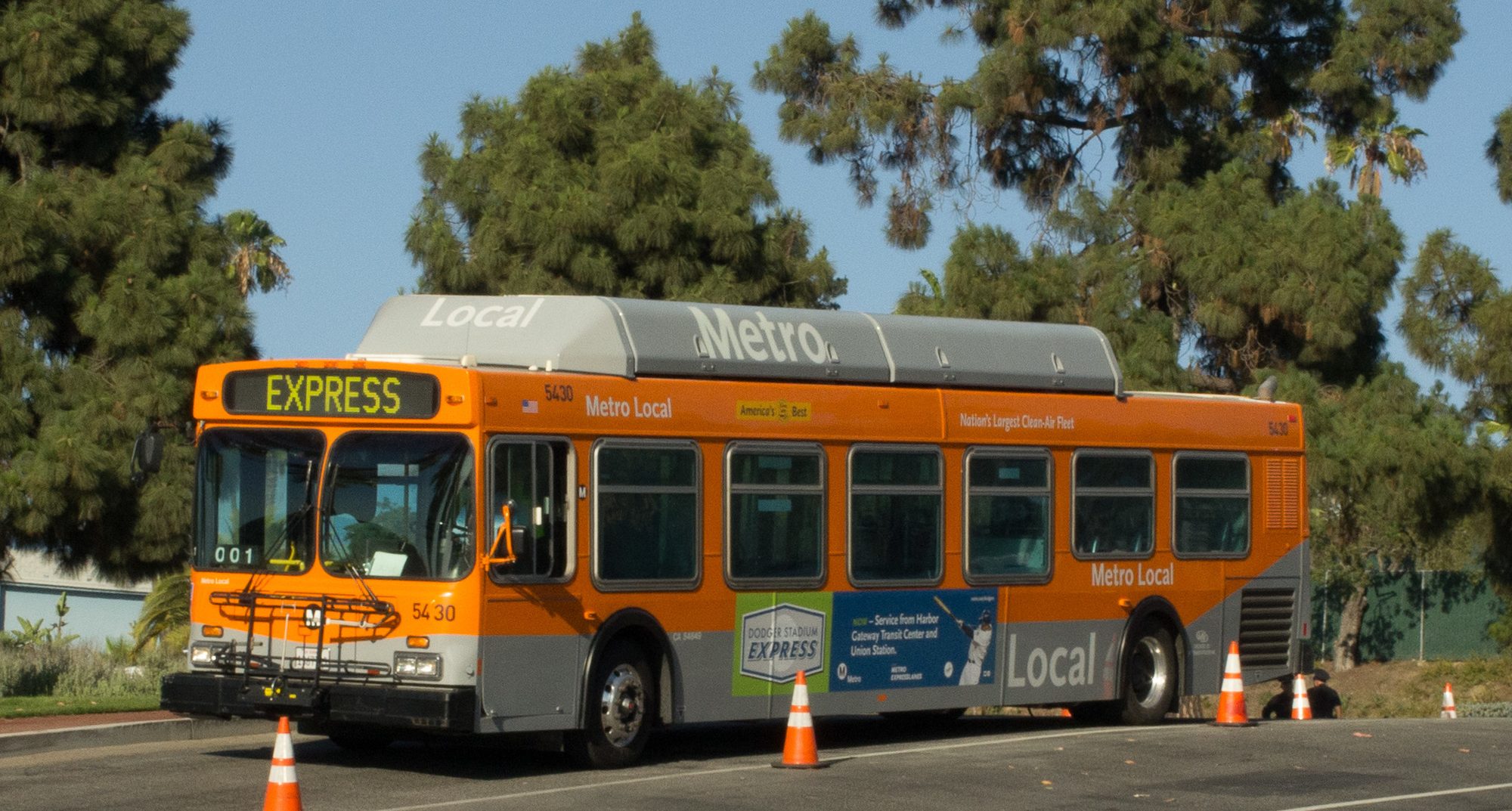
If you are staying Downtown or coming from the South Bay, the Dodger Stadium Express is the public-transit answer to a park with no train station, and it is free with a game ticket. It is run by LA Metro (the Los Angeles County Metropolitan Transportation Authority, the agency that runs the region’s buses and trains).
From Union Station. Union Station is Downtown LA’s main rail hub, where the Metro trains, Amtrak, and Metrolink commuter rail all connect. Board the Express on the West/Alameda side of the station, the downtown-facing side. The ride up to the stadium is free with your game ticket. You do not need a TAP card for the Express. (A TAP card is LA Metro’s reloadable fare card, the thing you need to ride regular Metro trains and buses. The Dodger Stadium Express is the exception: a game ticket is your fare.)
From the South Bay. There are five stops on the South Bay line: Slauson, Manchester, Harbor Freeway, Rosecrans, and Harbor Gateway Transit Center (Bay 9).
The schedule. Buses run from about 2.5 hours before first pitch through the end of the 2nd inning, roughly every 30 minutes. Return service ends 45 minutes after the final out (or 20 minutes after post-game events like fireworks), so do not linger too long if the Express is your ride home. Drop-off is behind center field and at the Top Deck; South Bay shuttles drop behind right field.
Getting to Union Station first
If you are staying Downtown without a car, take Metro rail to Union Station, then the free Express up the hill. Several Metro lines pass through Union Station, so let your maps app stitch the leg from your hotel to the station for you, then catch the Express on the West/Alameda side.
Driving and parking
Driving is a real option, and for a lot of fans it is the default, especially a group of three or more where the per-person rideshare cost adds up, or anyone already in a rental car for the rest of an LA trip. The trade-off is the one everybody warns about: the slow crawl out of the lots after the game. Go in expecting it and it is manageable.
A few things to know.
- General parking runs about $27 in advance and about $30 at the gate (2025 figures; the closer preferred lots cost more).
- Buy your parking in advance. It is cheaper than paying at the gate and it speeds up entry on a busy night.
- Park to match your ticket level. This is the Dodger Stadium quirk that trips up first-timers. The lots are terraced by elevation and tied to the seating tiers and gates, so a Top Deck ticket wants an upper lot and the Field Level wants a lower one. Park in the wrong tier and you are looking at a climb or a long walk. We cover the tier system in the where to sit guide and the first-timer’s guide.
SpotHero for a spot in advance
For a lot reserved ahead of time, SpotHero is the simplest option for Dodger Stadium parking. SpotHero is a parking-reservation app: you book a stadium-area or nearby lot in advance, prepay in the app, and drive straight to it on game day. Prices spike by event, so check live.
How it works:
- Open the SpotHero app or the Dodger Stadium parking page.
- Enter your game date and time.
- Filter by walking distance, price, or covered versus open.
- Reserve and pay in the app.
- Show the digital pass at the lot entrance.
Heads up: the SpotHero link above is an affiliate link. If you book through it, we get a small cut at no extra cost to you. It doesn’t change what we recommend.
When driving is the right call
- You are a group of three or more, where the parking cost beats per-person rideshare fares.
- You are staying somewhere outside an easy Union Station or Express connection.
- You want full flexibility on when you leave after the game (and you are fine with the lot crawl as the price of it).
- You already have a rental car for the rest of your LA trip.
From the airport
Los Angeles International (LAX) is the main airport, with Hollywood Burbank (BUR) a smaller option that some visitors find easier. From either one you have two ways in: a rideshare or cab straight to the stadium, which is the simplest with luggage, or Metro rail to Union Station and then the free Dodger Stadium Express up the hill.
Gates and entering at your level
Go to the gate that matches your ticket level and is closest to where you parked or got dropped off. Usually the only gate question is which one is nearest. Here it matters more, because the gates are tied to the seating tiers and the terraced lots, so the closest gate is usually the one your lot and your ticket level already point you to.
The fan-cited gates are Sunset Gate, Golden State Gate, Academy Gate, and Downtown Gate, each feeding particular lots and levels, plus the Top Deck and Reserve entries.
One thing to know going in: movement between levels has historically been limited at Dodger Stadium, meaning you generally stay on the level your ticket is for rather than roaming up and down the tiers.
Accessibility
See something out of date at Dodger Stadium, or know it better than we do? Tell us.