The Bleacher Bound Guide to Camden Yards
Visiting the Orioles in Baltimore. The B&O Warehouse and Eutaw Street, the open-air bowl, the moved-and-moved-back left-field wall, Boog's BBQ, a walkable downtown next to the Inner Harbor, and trains that stop right at the gate.
What this guide is
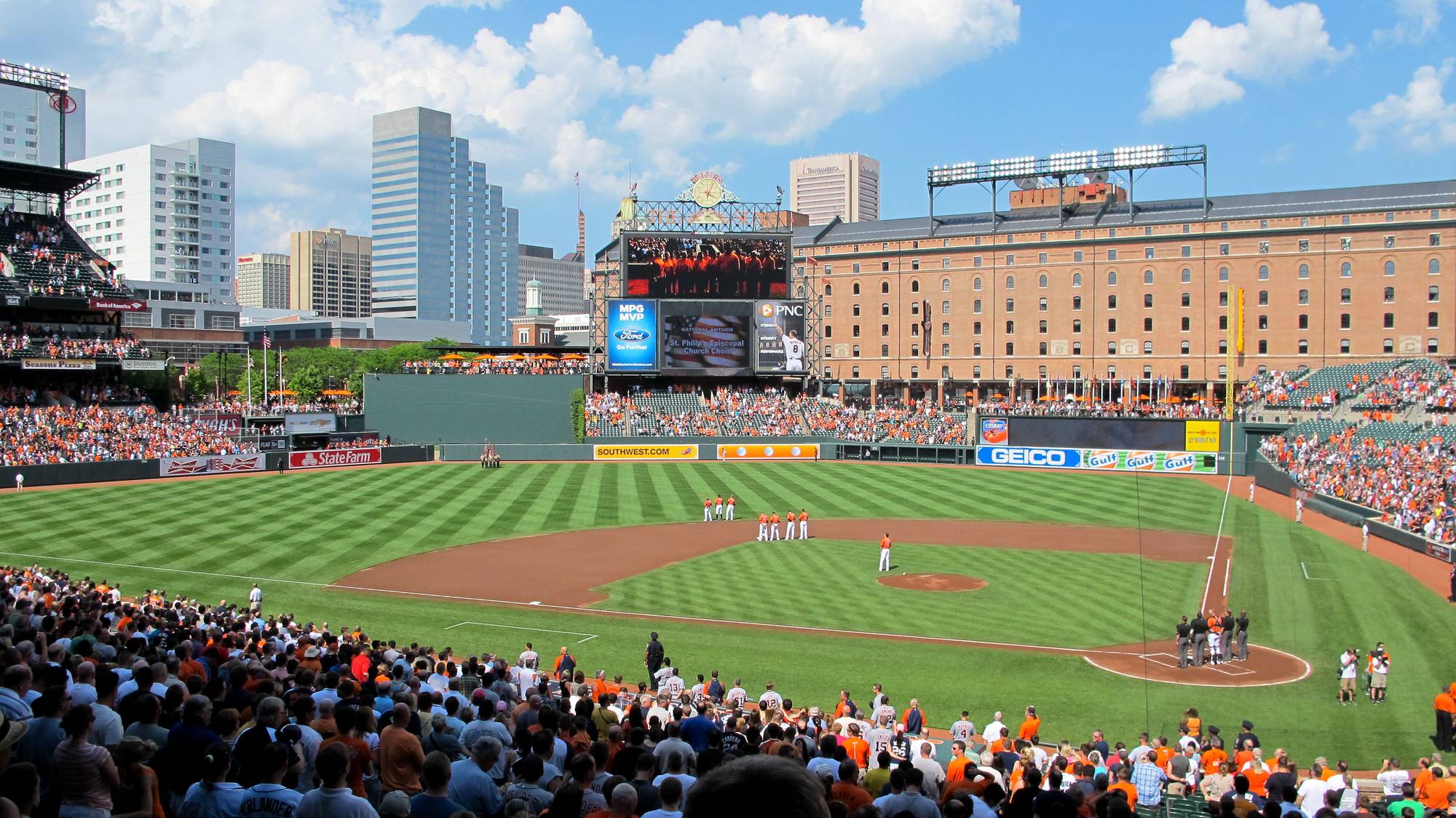
Camden Yards sits at 333 West Camden Street in downtown Baltimore, a few blocks off the Inner Harbor, with Camden Station and its trains at the gate. It opened on April 6, 1992 as the replacement for Memorial Stadium, and it changed how ballparks get built. Before Camden, new parks were concrete multi-use bowls on the edge of town. Camden put a baseball-only park downtown, faced it toward an old brick railroad warehouse, and let the city be the backdrop. Nearly every park built since has copied the idea.
This guide is built for two readers. The first is the Orioles fan who knows the place and wants the sharper moves: where the shade actually is on a hot afternoon, whether the left-field wall still plays the way it did a couple years ago, and which seats give you the most for the money. The second is the traveling fan planning a Baltimore trip around a game. For that reader, the things to get right up front are that this is a genuinely walkable downtown park, that you can bring your own food in, and that the trains drop you at the door.
We work through it in eight sections. Each one ends with links to the others, so you can follow the planning the way you actually plan it.
Camden Yards in 90 seconds
What makes this park distinct:
The B&O Warehouse and Eutaw Street are the signature. The brick warehouse beyond right field runs 1,016 feet, one of the longest buildings on the East Coast, and the team offices are inside it. Between the warehouse and the field is Eutaw Street, a public promenade you can walk on a game day, with brass plaques set into the pavement marking the 134 in-game home runs that have landed there since 1992. No batter has ever hit the warehouse on the fly during a game. The only ball to reach it was a Ken Griffey Jr. shot in the 1993 Home Run Derby, marked by a plaque about two-thirds of the way up a white column.
It started the retro-ballpark era. Camden Yards opened April 6, 1992, designed by HOK Sport (now Populous), the first retro-classic downtown park and the template the modern era followed. It is also where Cal Ripken Jr. played his 2,131st straight game on September 6, 1995 and passed Lou Gehrig’s record that most people thought would never fall.
It is a walkable downtown park, not an isolated one. The Inner Harbor is about a 10-minute walk east, Federal Hill sits just south, and the bar cluster at the gates (Pickles Pub, The Bullpen) starts the pregame right outside the turnstiles. The Babe Ruth Birthplace Museum is two blocks away, with painted baseballs on the sidewalk leading you back to the park. You can plan a full day on foot here.
If it’s your first visit, do these three things
The three-line version of the first-timer guide.
Pack light on bags, and know you can bring your own food. Camden is a clear-bag park: one clear bag up to 12 by 6 by 12 inches, a one-gallon clear freezer bag, or a small non-clear clutch up to 5 by 7. But it also lets you bring your own food in, plus one factory-sealed non-alcoholic drink up to 20 ounces (no cans, no glass). That food allowance is unusual and a real money-saver for families.
Know the alcohol cutoff is later than most parks. Beer sales here run through the end of the 8th inning, or three and a half hours after first pitch, whichever comes first. That is later than the 7th-inning cutoff at a lot of parks, and it is a separate thing from the seventh-inning stretch in the middle of the 7th.
Take the train if you can. Camden Station sits right at the gate, and both the Light Rail (Maryland’s light-rail line, running from the northern suburbs down through BWI Airport) and the MARC Camden Line (commuter rail, including from Washington, DC) stop there. From DC you can come up for the game without a car.
At a glance
| Opened | April 6, 1992 (Orioles 2, Cleveland Indians 0; Rick Sutcliffe complete-game shutout) |
| Address | 333 West Camden Street, Baltimore, MD 21201 (downtown, a few blocks west of the Inner Harbor) |
| Replaced | Memorial Stadium (Orioles home 1954-1991) |
| Capacity | Approximately 44,487 |
| Tenant | Baltimore Orioles (AL East) |
| Owner | David Rubenstein group (Inner Harbor Sports), bought from the Angelos family in 2024 for $1.725 billion; the group includes Cal Ripken Jr. |
| Architect | HOK Sport (now Populous) |
| Signature features | The 1,016-foot B&O Warehouse beyond right field; the public Eutaw Street promenade with brass home-run plaques in the pavement; the open-air bowl downtown |
| Left-field wall (current, 2025) | Deepest points roughly 374 to 376 feet, wall about 6’11” to 8 feet; brought in 9 to 20 feet and lowered from the 2022 “Walltimore” setup |
| Eutaw Street | 134 in-game home runs have landed there (1992-2025), each marked by a brass plaque; the warehouse has never been hit in a game (only Griffey, 1993 Home Run Derby) |
| World Series titles | 3 (1966, 1970, 1983), all won at Memorial Stadium before Camden opened |
| Alcohol cutoff | End of the 8th inning, or 3.5 hours after first pitch; two per person per transaction, 21 and over, ID required |
| Bag policy | Clear bag up to 12 by 6 by 12 inches, a one-gallon clear freezer bag, or a clutch up to 5 by 7; outside food allowed, plus one factory-sealed non-alcoholic drink up to 20 oz; no cans, no glass |
| Gates | A, C, D, H standard (others as needed); Gate A is by the Eutaw Street corridor, team store, and Boog’s |
| Transit | Camden Station at the gate: Light Rail (Hunt Valley-BWI Airport line) and the MARC Camden Line commuter rail, including from Washington, DC |
| Recent trajectory | 2023 AL East champs (101 wins); 2024 wild card (91 wins); 2025 down year (75-87); 42-48 and fourth in the AL East as of early July 2026 |
The eight sections
Where to Sit at Camden Yards
The open-air bowl from Field Level up to the Upper Deck, the sun-and-shade trade-off on day games (the Terrace Level under the Club overhang and the covered upper sections get the shade, the field boxes and bleachers are most exposed), the Eutaw Street and right-field side where the park’s identity lives, the value tiers, and the moved-and-moved-back left-field wall and what it means for home-run watching now.
What to Eat at Camden Yards
The Baltimore identity (crab, Old Bay, pit beef), Boog’s BBQ on Eutaw Street as the lead (pit-beef and brisket sandwiches, started by Boog Powell on opening day 1992), the crab-cake and crab-soup spots, local crossovers like Ekiben’s fried-chicken bao, the bring-your-own-food allowance, and the end-of-8th alcohol cutoff.
Around Camden Yards
The pregame bars right at the gates (Pickles Pub, The Bullpen), the bigger Federal Hill scene a short walk south, the Inner Harbor waterfront a few minutes east, and family options including the Babe Ruth Birthplace Museum two blocks away and the National Aquarium. An honest read on what is walkable versus what needs a short ride.
Getting to Camden Yards
Rideshare as the easy option, then driving and the official Lots A-H (general day-of parking in Lots F, G, H), then the strong rail story: Camden Station at the gate with the Light Rail and the MARC Camden Line from Washington, DC. SpotHero to book parking ahead.
Where to Stay Near Camden Yards
A real walkable Inner-Harbor cluster: the closest hotel overlooking the park, the historic options (a hotel inside the 1906 former B&O Railroad headquarters), boutique stays, and mid-range walkable picks, all within about a 10-minute walk. The no-budget-tier brand standard applies.
First-Timer’s Guide to Camden Yards
The clear-bag policy and the bring-your-own-food allowance, the end-of-8th alcohol cutoff (separate from the seventh-inning stretch), gate timing and “closest gate first,” the train arrival, and the things to see (walk Eutaw Street for the warehouse and the home-run plaques, the Babe Ruth statue, the kids’ area, the Oriole Bird).
Why Camden Yards Matters
The 1992 opening and the retro era it launched, the B&O Warehouse and Eutaw Street as architectural identity, Cal Ripken Jr. breaking Gehrig’s streak in 1995, the franchise legends (Brooks Robinson, Frank Robinson, Eddie Murray, Earl Weaver), the three pre-Camden World Series titles, Babe Ruth born two blocks away, and the modern arc from a long losing stretch to contention and the 2024 Rubenstein ownership change.
When to Visit Camden Yards
The humid mid-Atlantic weather by month (raw in April, hot and humid in July and August, excellent in September and October), the AL East draws (Yankees, Red Sox) and the Beltway Series with the Nationals, how contention has shifted demand, day-versus-night planning around the Inner Harbor, and a current-season schedule-highlights block.
Quick answers
What’s the best time to visit Camden Yards? Late May into June, or September into early October, are the most comfortable windows: warm without the deep humidity of July and August, which is real in Baltimore. April can be raw and cool, so bring layers. September is not a low-crowd month, so plan tickets on the opponent and weeknight-versus-weekend rather than the calendar. Midweek games against non-marquee opponents are the value window; Yankees and Red Sox weekends draw the most. Full month-by-month.
Where are the value seats at Camden Yards? Think in tiers rather than one best seat. The Upper Deck infield behind the plate is the cheapest tier with a clear, centered view, though it is the most exposed on a hot day game. The Terrace Level under the Club overhang is the shade-and-comfort pick on the lower level without the field-box price. And the Field Level corners and outfield, including the right-field bleachers near Eutaw Street, get you close and put you next to the park’s signature feature without the infield-box premium. Full seating breakdown.
How do I get to Camden Yards? The trains stop at the gate. Camden Station sits right outside the park, and both the Light Rail (Maryland’s light-rail line, running from the northern suburbs through BWI Airport) and the MARC Camden Line commuter rail stop there, the MARC including service up from Washington, DC. If you drive, the official Lots A-H surround the park with general day-of parking in Lots F, G, and H, most wanting a pre-purchased pass, and there are tens of thousands of garage spaces across downtown within a short walk. Rideshare drop-off and pickup is downtown with the usual post-game surge. Full transit guide.
What’s the alcohol cutoff at Camden Yards? Beer sales run through the end of the 8th inning, or three and a half hours after first pitch, whichever comes first. That is later than the 7th-inning cutoff a lot of parks use. It is a separate thing from the seventh-inning stretch in the middle of the 7th. Two per person per transaction, 21 and over, with a valid photo ID.
What’s the bag policy at Camden Yards? Camden is a clear-bag park: one clear bag up to 12 by 6 by 12 inches, a one-gallon clear freezer bag, or a small non-clear clutch up to 5 by 7 inches. The part that surprises people is that you can also bring your own food in, plus one factory-sealed non-alcoholic drink up to 20 ounces. No cans and no glass.
What makes Camden Yards different from other ballparks? It is the park that started the modern ballpark era. When it opened in 1992 it was the first retro-classic downtown park, and nearly every team that built since copied the idea. The 1,016-foot B&O Warehouse stands beyond right field, and the Eutaw Street promenade in front of it is paved with brass plaques for the home runs that have landed there. It is where Cal Ripken Jr. broke Lou Gehrig’s consecutive-games record in 1995. And it is genuinely walkable to the Inner Harbor and Federal Hill, with trains at the gate, which makes a game here one of the easier big-league trips to plan on the East Coast.
A note on what’s coming
Bleacher Bound launched with Coors Field as the first full ballpark guide, followed by Wrigley Field and Rate Field. Camden Yards is part of the phased rollout to the rest of the majors. The eight-section structure is the template every park guide uses.
If you have a Camden Yards detail you think we missed, tell us. Local-knowledge tips are how this guide stays sharp.