Why Camden Yards Matters
The park that changed everything
Oriole Park at Camden Yards opened on April 6, 1992. The Orioles beat the Cleveland Indians 2-0 that day, Rick Sutcliffe threw a complete-game shutout, and Chris Hoiles drove in Sam Horn for the first run ever scored there. It replaced Memorial Stadium, where the Orioles had played since 1954.
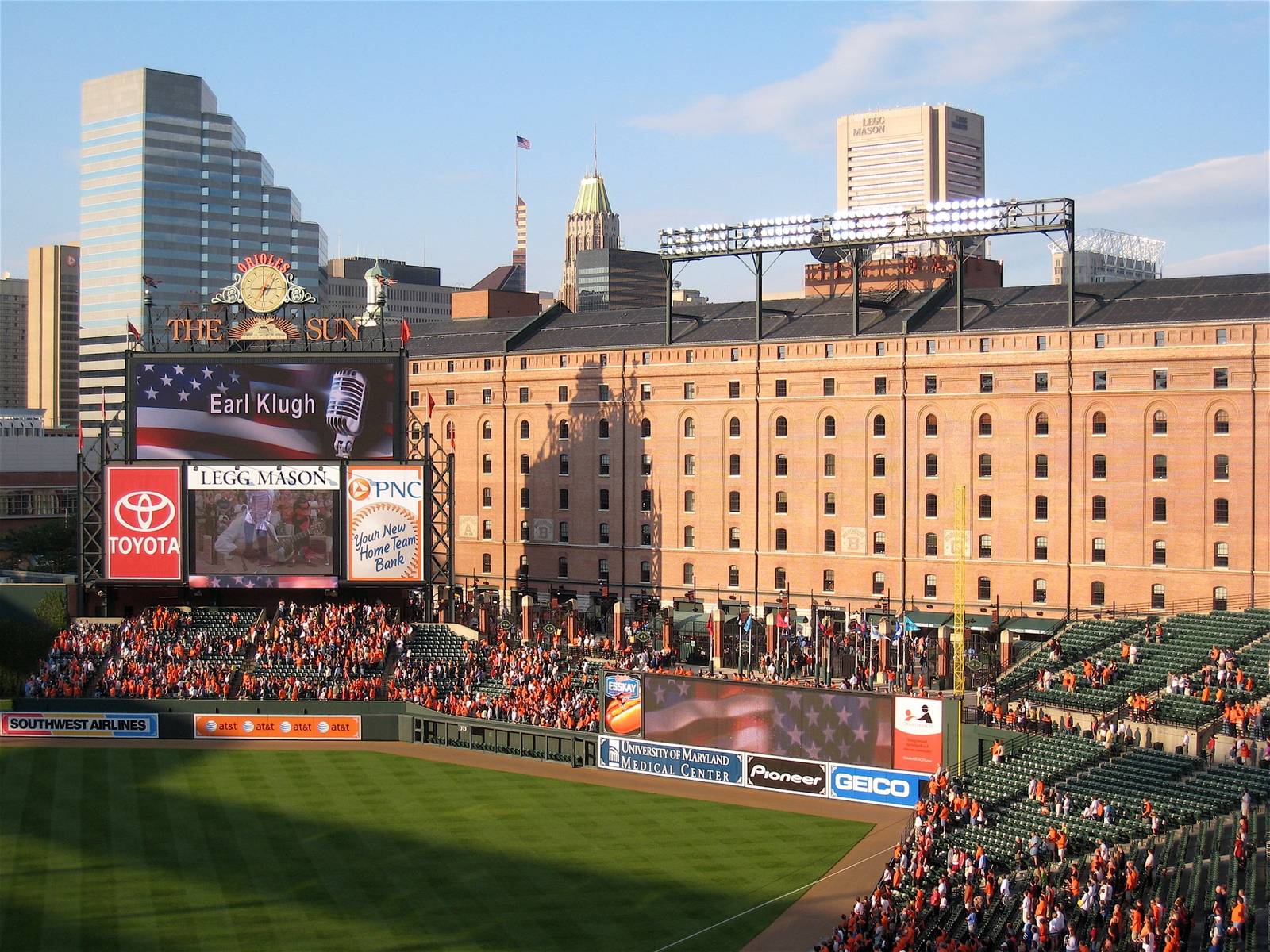
What made Camden Yards matter was not the score. It was the design. HOK Sport, now Populous, built a park that looked backward instead of forward: a real downtown ballpark with an old-fashioned brick-and-steel feel, asymmetric outfield, intimate seating close to the field, dropped into the middle of a city rather than ringed by a sea of suburban parking. It was the first of the retro-classic downtown parks.
Nearly every park built in the thirty-odd years since has copied the template. The downtown location, the exposed steel, the quirky outfield dimensions, the city skyline framed beyond the wall: that is the Camden Yards playbook, and you can see it in Cleveland, in Denver, in San Francisco, in dozens of parks that followed. If you have been to a ballpark built after 1992 and thought it felt classic, you were standing in something Camden Yards started.
The warehouse and Eutaw Street
The B&O Warehouse is the signature. It is the long brick building beyond right field, 1,016 feet end to end, one of the longest buildings on the East Coast, and the architects built the park up against it instead of tearing it down. Between the warehouse and the field runs Eutaw Street, a public promenade you can walk on a game day.
Set into the Eutaw Street pavement are brass plaques, one for every home run that has landed out there in a game. The count was 134 of them through the 2025 season. What no ball has ever done is hit the warehouse itself during a game. The only one to reach it was Ken Griffey Jr., and that came in the 1993 Home Run Derby, not a real at-bat. The spot is marked by a plaque about two-thirds of the way up a white column.
Cal Ripken and 2131
The defining moment in the park’s history arrived on September 6, 1995. Cal Ripken Jr. played his 2,131st consecutive game that night, passing Lou Gehrig’s record that had stood since 1939 and that a lot of people had assumed would never fall. When the game became official in the middle of the fifth inning, the numbers on the warehouse changed to read 2131 and the crowd would not let the game continue. Ripken took a lap around the field.
He kept playing. The streak finally ended at 2,632 games, running from May 30, 1982 to September 19, 1998, and he chose when to stop it himself. Gehrig’s mark had lasted 56 years. Ripken’s will likely last longer. No active player is anywhere close, and the way rosters are managed now, the record reads like something from a different sport.
The legends who came first
The Orioles were a great franchise long before Camden Yards existed, and the names that anchor the team’s story mostly predate the park.
Brooks Robinson played third base in Baltimore for 23 years, won 16 straight Gold Gloves, and earned the nickname “the Human Vacuum Cleaner” for what he did to ground balls down the line. He was the 1970 World Series MVP. Frank Robinson arrived in a 1965 trade and won the American League Triple Crown and MVP in 1966, his first season in Baltimore. He later managed the Orioles from 1988 to 1991, including Ripken’s prime, and he had already made history in 1975 as the first Black manager in Major League Baseball.
Eddie Murray switch-hit his way to 500 home runs and 3,000 hits, one of only a handful of players ever to reach both. Earl Weaver ran the dugout for most of the great years and went to the Hall of Fame for it. The franchise won the World Series in 1966, 1970, and 1983, all of it at Memorial Stadium, all of it before the first pitch was ever thrown at Camden Yards.
Babe Ruth, two blocks away
Babe Ruth was born in Baltimore on February 6, 1895, in a row house at 216 Emory Street, about two blocks from where Camden Yards now stands. The house is the Babe Ruth Birthplace Museum today. His father once ran a saloon on ground that sits near what is now center field. The greatest player in the game’s history grew up in the neighborhood the ballpark went on to revive.
The long losing years
The honest part of the story is the stretch in the middle. After the 1997 team came within a game of the World Series, the Orioles did not post a single winning season from 1998 through 2011. Fourteen years. The park was still beautiful, but the team inside it was mostly bad, and Camden Yards spent a long time as a gorgeous building hosting forgettable baseball.
It got worse before the rebuild took hold. The 2018 club lost 115 games, and the 2021 club lost 110. Those were tear-it-down-to-the-studs seasons, the kind a front office accepts on purpose to stockpile young talent. The fans who kept coming through those years earned what came next.
The rebuild and the new owners
The young talent paid off. The 2023 Orioles won 101 games and the American League East, their first division title since 2014, built around a homegrown core: catcher Adley Rutschman, shortstop Gunnar Henderson, and a wave of prospects behind them. The 2024 team won 91 and made the postseason as a wild card.
The postseason itself has been the sore spot. The 2023 club got swept by Texas in the Division Series, and the 2024 club got swept by Kansas City in the wild-card round, running the franchise’s postseason losing streak to ten straight games across multiple seasons. A team can build a winner and still be waiting on the October breakthrough, and that is where the Orioles sit.
The ownership changed at the same time. In January 2024 a group led by David Rubenstein, the Baltimore-born Carlyle Group co-founder, agreed to buy the team from the Angelos family for $1.725 billion; the Maryland Stadium Authority approved the sale that March. Cal Ripken Jr. is part of the ownership group. The team also signed a roughly 30-year lease to stay at Camden Yards, which unlocked about $600 million in public bonds for stadium improvements plus development rights around the park. The building that started the retro era is getting reinvested in for the next generation of it.
See something out of date at Camden Yards, or know it better than we do? Tell us.