Getting to Fenway Park
The quick read
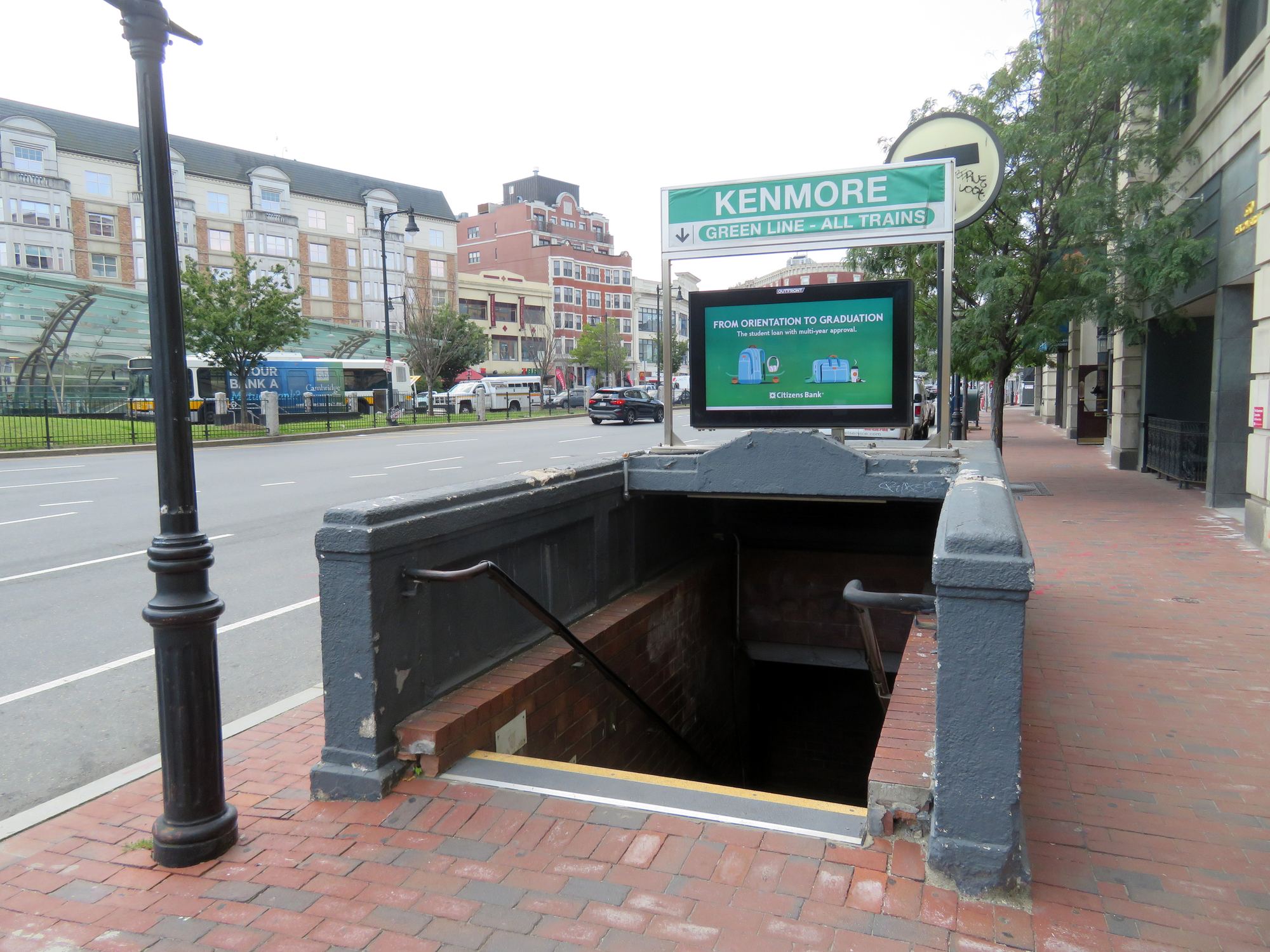
Fenway Park sits in the Fenway-Kenmore neighborhood, wedged into a tight grid of Boston city streets, and parking around it is bad: limited, expensive, and slow to get out of. The good news is you almost never need a car. The lead move is the T, the subway run by the MBTA (the Massachusetts Bay Transportation Authority). Its Green Line drops you at Kenmore station, about 1,000 feet from the gates, which beats fighting for a parking spot by a wide margin.
If you are coming in from the western suburbs, the commuter rail runs to Lansdowne station, steps from the park. Rideshare is the easy backup, and driving works for a small group if you really want it, but be honest with yourself: the T beats it badly here. When you do drive, SpotHero is the simplest way to lock a spot in advance.
One thing beats all of this: drop “Fenway Park” into your maps app with your hotel as the start and switch to transit directions. It has the Green Line and commuter-rail schedules built in and will tell you in fifteen seconds what actually works from where you are.
Fares, lot rates, rideshare zones, and gate times shift year to year. Give anything time-sensitive below a quick check against mbta.com or mlb.com/redsox before you build a plan around it.
Check your own trip in the maps app
Start here. Type “Fenway Park” into Apple Maps or Google Maps, set your hotel as the start, and switch the directions to transit. Both apps have the MBTA subway and commuter-rail schedules built in, so they stitch the legs together and give you the real time and cost from your exact starting point. From most of downtown and Back Bay it will tell you to take the Green Line or just walk. From farther out it sorts the train-versus-rideshare question faster than any guide can.
The T (Green Line)
For a visitor based downtown, in Back Bay, or anywhere along the line, the Green Line is the easiest way to the park. The Green Line is the MBTA’s light-rail line, and its B, C, and D branches all stop at Kenmore station, about 1,000 feet north of the park. The D branch also stops at Fenway station, which is close as well.
One fan tip worth knowing: on a game day, taking the B or C branch to Kenmore is often less crowded than the D branch to Fenway, since Fenway station draws a heavier game-day load. Either gets you there on foot in a few minutes.
Fares and how to pay
The subway fare is cheap and flat: a one-way ride is about $2.40 with a CharlieCard, the MBTA’s reloadable fare card, and that fare includes up to two transfers. One thing to handle before you go: CharlieCards are not sold at Fenway Park. Buy one ahead of time at a fare machine in any subway station or at a partner location, so you are not stuck sorting out payment in the game-day crush.
Commuter rail
If you are coming in from the western suburbs, the MBTA’s Framingham/Worcester Line commuter rail stops at Lansdowne station, between Beacon Street and Brookline Avenue, steps from the park. (The station was renamed from Yawkey to Lansdowne in 2019.) It connects Worcester and the western suburbs to Boston, with stops at Boston Landing, Lansdowne, Back Bay, and South Station, so it is the easy out-of-town-without-driving option.
One thing to check for your date: confirm whether the line is running all-day service or game-oriented service, since the schedule pattern can vary.
Rideshare
Rideshare is the easy backup when transit does not fit your night. Designated pickup and drop-off zones are cited near the intersection of Boylston Street and Kilmarnock Street, and along Lansdowne Street and Brookline Avenue. Curbside zones are managed starting at 5 p.m. on game days, with short time limits for drivers at the curb, so be ready to hop in or out quickly.
The ride in is simple. The ride home is the part that catches people: when the park empties at once, the apps surge for the first 20 to 30 minutes after the last out. Two ways to handle it: walk a few blocks away from the gates before you request, since stepping outside the busiest pickup zone can drop the price, or post up at a Lansdowne Street or Kenmore Square bar for half an hour and let it fade. Those spots are in the around-the-ballpark guide.
Driving and parking
Driving is a real option, especially for a small group where per-person Green Line fares add up. But it is the weakest way to get to Fenway, and worth saving for the case where the rest of your trip already has you in a car. Parking near the park is very limited and very expensive.
- Street and surface lots near the park commonly run $35 to $50 or more on a game day.
- Prepaid garages near the park can run higher still, well into the triple digits on high-demand dates.
- The Lansdowne Street Garage (across from the park) is a popular pre-bookable option.
The other trade-off is the crawl out of the neighborhood after the game, on streets that were not built for it. If you are set on driving, parking a bit farther out and walking in usually beats fighting for the closest spot.
SpotHero for a spot in advance
For a lot reserved ahead of time, SpotHero is the simplest option for Fenway parking. SpotHero is a parking-reservation app: you book a Fenway-area or downtown lot in advance, prepay in the app, and drive straight to it on game day. Prices spike by event, so check live.
How it works:
- Open the SpotHero app or the Fenway Park parking page.
- Enter your game date and time.
- Filter by walking distance, price, or covered versus open.
- Reserve and pay in the app.
- Show the digital pass at the lot entrance.
Heads up: the SpotHero link above is an affiliate link. If you book through it, we get a small cut at no extra cost to you. It doesn’t change what we recommend.
When driving is the right call
- You are a group of three or more, where parking math beats per-person Green Line fares.
- You are staying well outside the city and outside an easy Green Line or commuter-rail connection.
- You want full flexibility on when you leave after the game.
- You already have a rental car for the rest of your Boston trip.
From the airport
Boston Logan International (BOS) connects to the city by the MBTA and by rideshare. On the T, the routing runs via the Blue Line with a transfer, or via the Silver Line bus from the terminals, into the subway system toward Fenway. A rideshare or cab from the terminal works too, and may be simpler with luggage.
Gates
Go to whichever gate is closest to where you are coming from. That is the practical answer for almost everyone: your Green Line stop, your hotel, your lot, or the bar you were just at. Fenway is wedged into a city block and the concourses are narrow, so you will burn more time working around the outside of the park to a “better” gate than you will save.
The park has lettered gates (A through E) spread around it, with entrances off Jersey Street, Brookline Avenue, Van Ness Street, Ipswich Street, and Lansdowne Street. Coming off the Green Line at Kenmore, you will walk down toward the closest one.
Gate opening times
Gates generally open 90 minutes before first pitch, with Red Sox Nation members getting in earlier (around 2.5 hours before) through a designated gate.
Bag check
Fenway runs a strict bag policy with screening at every gate: single-compartment bags up to 12 by 12 by 6 inches, with exceptions for medical items and diaper bags. Backpacks, multi-compartment bags, and duffels are not allowed, and there is no hard cooler or glass (soft-sided coolers are OK). If you bring a banned bag, third-party lockers operate atop the Lansdowne Garage across from Gate E for a fee. The full policy and what you can carry in is in the first-timer’s guide.
See something out of date at Fenway Park, or know it better than we do? Tell us.