Old Comiskey to Rate Field: the South Side's Ballpark
The quick read
Rate Field opened in 1991 as new Comiskey Park, the replacement for the old Comiskey that stood right next door for 80 seasons. The building has carried four names in 35 years, hosted a World Series sweep that ended an 88-year title drought, watched Mark Buehrle throw a perfect game, and sits right next door to the ground where the 1919 Black Sox threw the World Series. It is the South Side’s ballpark, and the South Side’s history runs through it. This is the long version: the parks, the scandal, the exploding scoreboard, 2005, the worst season in modern baseball, and the pope who sat in Section 140.
Old Comiskey Park: the Baseball Palace of the World
The story starts right next door. Old Comiskey Park opened in 1910 at 35th and Shields, built by Charles Comiskey, the original White Sox owner. The architect was Zachary Taylor Davis, who four years later designed Wrigley Field on the North Side. Comiskey called it the Baseball Palace of the World, and for a while it was the grandest park in the game.
It stood for 80 seasons. It hosted the first MLB All-Star Game in 1933. It saw its first night game in 1939. By the time it closed after the 1990 season it was the oldest ballpark still in use in the majors. The new park opened right next door in 1991 and the old one came down that same year. The diamond did not disappear entirely, though. The exact location of old home plate is still marked in the parking lot today, which is its own short section further down.
The 1919 Black Sox scandal
The most consequential thing that ever happened in White Sox history happened at old Comiskey. In 1919, eight White Sox players, including “Shoeless” Joe Jackson, conspired with gamblers to lose the World Series to the Cincinnati Reds in exchange for money. A jury acquitted them in a 1921 criminal trial, but the sport did not. Commissioner Kenesaw Mountain Landis banned all eight from professional baseball for life. The scandal gave baseball the “say it ain’t so, Joe” legend, which is almost certainly apocryphal but has outlived everyone who could confirm it. It also gave the movies two enduring films, “Eight Men Out” and “Field of Dreams.”
There is a recent wrinkle worth knowing. In 2025, Commissioner Rob Manfred lifted the permanent ineligibility of deceased banned players, which made Shoeless Joe Jackson and the other dead members of the 1919 team eligible for Hall of Fame consideration for the first time. A century after the fix, the door cracked open.
Bill Veeck and the exploding scoreboard
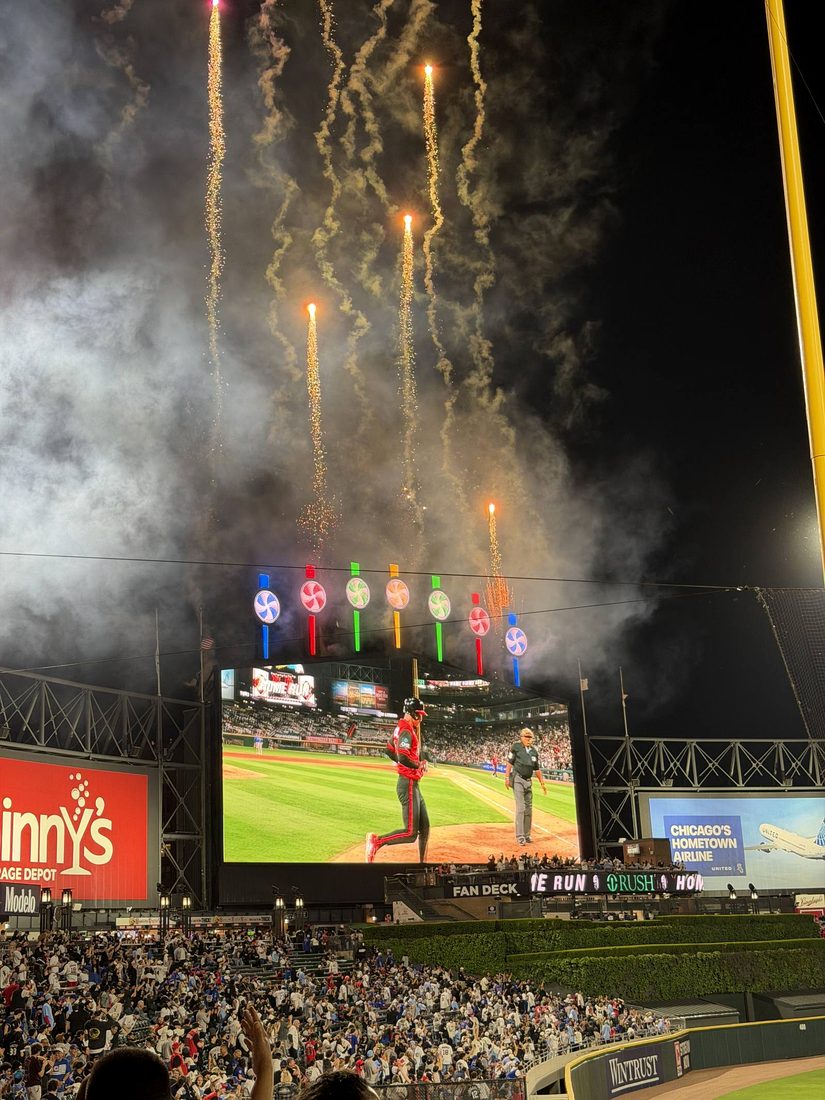
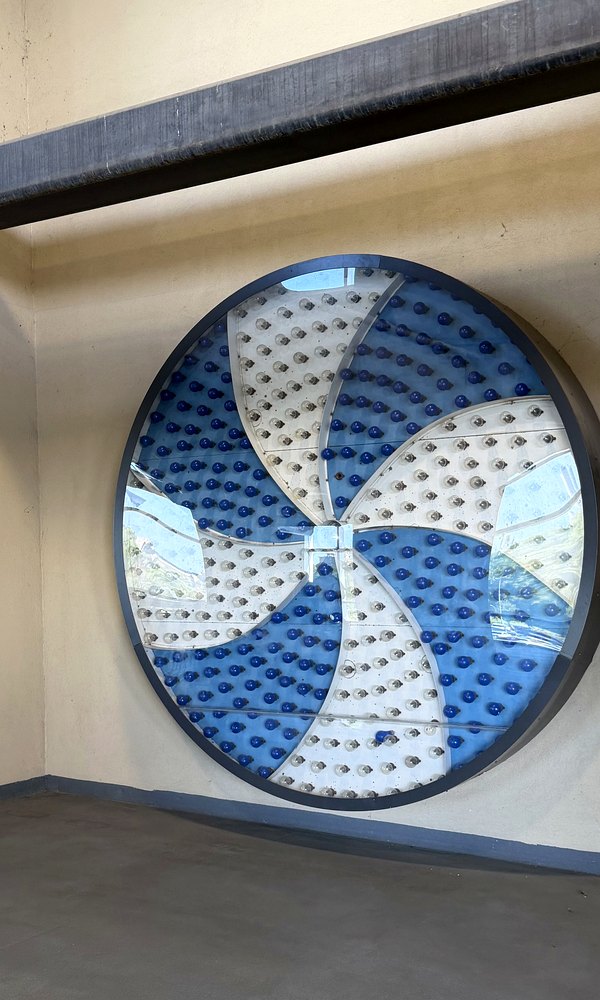
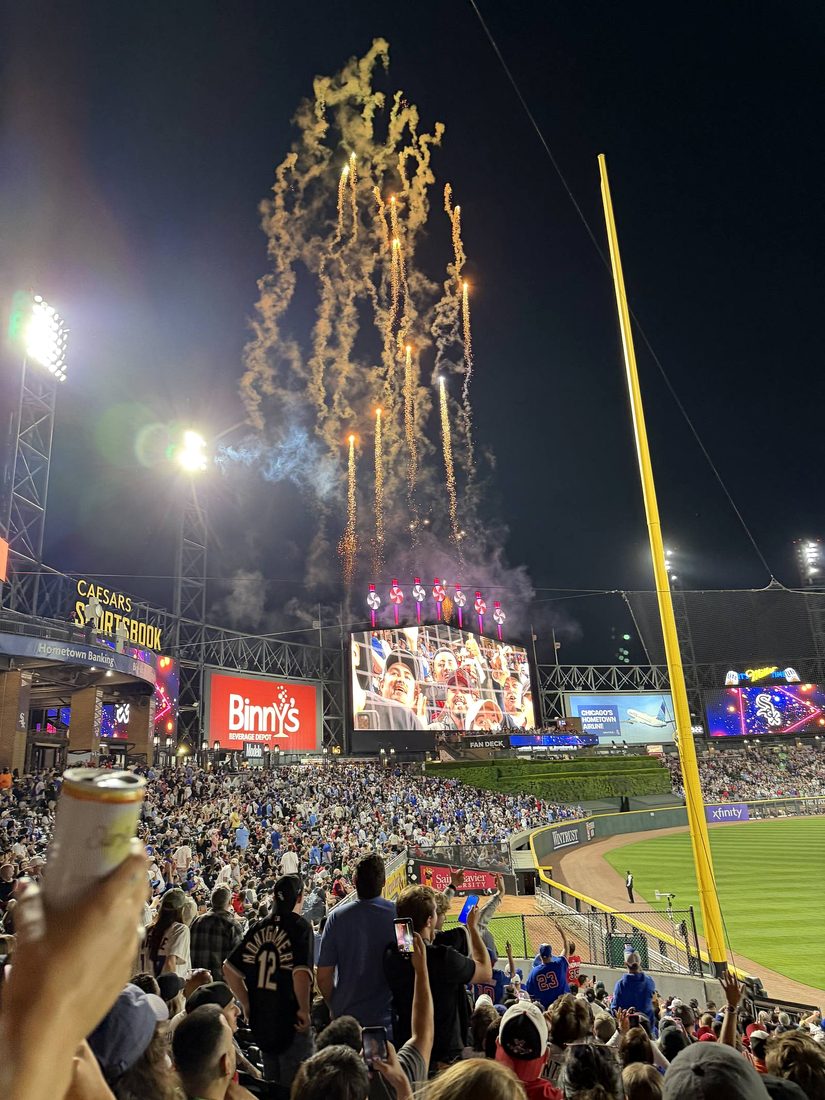
Bill Veeck owned the White Sox twice, from 1959 to 1961 and again from 1975 to 1981, and he is the reason Sox home runs still come with fireworks. In 1960 he installed the first exploding scoreboard in Major League Baseball at old Comiskey. When a Sox player went deep, the scoreboard erupted with fireworks, spinning pinwheels, and sound. The first time it went off was May 1, 1960.
Veeck was the most inventive promoter the game has produced. He once sent a little person, Eddie Gaedel, to bat for the St. Louis Browns in 1951. He invented Bat Day. He is in the Hall of Fame. Of everything he tried, the exploding scoreboard is the one that stuck to this franchise. The current park carries the idea forward: pinwheels spin and fireworks fire on a Sox homer and a Sox win, a direct visual line from the building you sit in back to the one that stood right next door.
Disco Demolition Night, 1979
One of the most infamous promotions in baseball history also belongs to old Comiskey, not the current park, and the distinction matters because people get it wrong constantly. On July 12, 1979, a local radio DJ named Steve Dahl, recently fired from a station that flipped to a disco format, teamed up with the Sox and Mike Veeck, Bill’s son, for a stunt between games of a twi-night doubleheader against the Detroit Tigers. Bring a disco record to be destroyed, get in for 98 cents.
Far more fans showed up than anyone planned for. An estimated 50,000-plus filled the park with thousands more locked outside. Between games, Dahl blew up a crate of disco records in center field. Thousands of fans poured onto the field, tore up the turf, lit fires, and did enough damage that the Sox had to forfeit the second game. The night is often called the symbolic end of the disco era. It happened at old Comiskey in 1979. The current park did not exist yet.
The Go-Go Sox, the South Side Hit Men, and Winning Ugly
Between the scandal and the modern park, three teams gave the South Side its identity. The 1959 “Go-Go Sox,” built on speed and defense, won the American League pennant, the franchise’s first since 1919, then lost the World Series to the Los Angeles Dodgers in six games.
The 1977 “South Side Hit Men” did not make the postseason, finishing 90-72, but they mashed home runs and brought the park back to life. That season is the usual origin point for a tradition you will still hear at Sox games. Nancy Faust, the longtime Sox organist, started playing “Na Na Hey Hey Kiss Him Goodbye” when an opposing pitcher got pulled, and the Comiskey crowd sang along. The taunt spread across baseball and into other sports from there. The song itself was recorded in 1969 by a studio group credited as Steam, written by Paul Leka, Gary DeCarlo, and Dale Frashuer. The Sox are the reason it became a stadium anthem.
The 1983 “Winning Ugly” Sox won 99 games and the AL West, the team’s first postseason trip since 1959. The nickname came from a Texas manager’s dismissive crack that the Sox were just winning ugly, which Sox fans promptly adopted as a badge. They lost the ALCS to the Baltimore Orioles, but 1983 stood as a high point through a long lean stretch.
The 2005 World Series
This is the high point of modern White Sox history, and it is the reason a lot of Sox fans can forgive the franchise almost anything else. The 2005 team, managed by Ozzie Guillen, went 99-63 in the regular season and then ran through October. They swept the Boston Red Sox in the Division Series. They beat the Los Angeles Angels of Anaheim in five games in the ALCS, with four straight complete games from the starting rotation, something that had not happened in the postseason in decades. Then they swept the Houston Astros 4-0 in the World Series.
It was the franchise’s first championship since 1917, the end of an 88-year wait. The series had its share of moments people still bring up: Paul Konerko’s grand slam in Game 2, Scott Podsednik’s walk-off home run later that same night, and Geoff Blum’s home run in the 14th inning of Game 3, the longest World Series game by time to that point. The clincher came in Houston, and the parade down LaSalle Street drew an estimated 1.75 million people. On the South Side, 2005 is not a memory. It is a reference point.
Mark Buehrle’s no-hitter and perfect game
Mark Buehrle was the Sox lefty of that era, a fast-working, durable starter who fans loved as much for his pace as his results, and he did something at this park that almost no one in baseball history has done. On April 18, 2007, he threw a no-hitter against the Texas Rangers. The only runner he allowed was wiped out on a caught stealing, so he faced nearly the minimum.
Two years later he topped it. On July 23, 2009, Buehrle threw a perfect game against the Tampa Bay Rays, the 18th perfect game in major league history. The play everyone remembers is the catch that saved it: center fielder Dewayne Wise, in the game as a late defensive replacement, climbed the wall to rob a home run leading off the ninth. Buehrle also set a major league record around that stretch by retiring 45 consecutive batters across starts. A no-hitter and a perfect game in the same uniform, two seasons apart, in the same building.
From New Comiskey to Rate Field: four names in 35 years
The current park opened on April 18, 1991, as new Comiskey Park, carrying the old name over from right next door. It has been renamed three times since, and the legacy names still matter because fans and search engines both remember them.
It became U.S. Cellular Field in 2003, when the company bought the naming rights in a deal reported at $68 million over 20 years. Fans shortened it to “The Cell.” In 2016 the Guaranteed Rate mortgage company took over, effective November 1, in a 13-year deal reported at $20.4 million, and brought a logo with a red arrow pointing down that Sox fans immediately read as an omen. Then on December 17, 2024, Guaranteed Rate trimmed its corporate name to simply Rate, and the ballpark followed. It is Rate Field now, still widely searched as Guaranteed Rate Field, and the same building either way.
The 2024 season
There is no soft way to write this, and Sox fans would not want one. The 2024 White Sox finished 41-121, the most losses by any team in modern major league history, meaning since 1900. They broke the 1962 New York Mets’ modern record of 120 losses by dropping their 121st on the final weekend of the season. Along the way they ran off losing streaks of 14 and 21 games, and the 21-game skid was the longest in American League history and tied the modern major league record. Manager Pedro Grifol was fired in August. The only team in the entire history of the sport with a worse record is the 1899 Cleveland Spiders, a pre-modern club that its own owners were deliberately gutting.
It is a brutal line in the franchise ledger, and it is part of the park’s story now. Anyone who sat through it earned the right to have it told straight.
Pope Leo XIV and Section 140
This one is unique to the South Side, and no other team in baseball can claim anything like it. On May 8, 2025, Cardinal Robert Prevost was elected pope and took the name Leo XIV, the first American-born pope. He grew up in the south suburbs of Chicago, in Dolton, and he is a lifelong White Sox fan. His brother, John Prevost, said so publicly on WGN, settling the question every Chicagoan asks first.
Network footage from Game 1 of the 2005 World Series caught then-Father Prevost in the stands. The White Sox went back, found his exact location, and determined he had sat in Section 140, Row 19, Seat 2. The team installed a permanent graphic at that seat marking the moment. The Sox have also extended an open invitation for Pope Leo XIV to throw a ceremonial first pitch, and team executives have said he expressed interest in doing it if his schedule allows.
Hawk Harrelson: the voice of the South Side
For a generation of Sox fans, the sound of White Sox baseball is one man. Ken “Hawk” Harrelson called Sox games on television for parts of four decades, most prominently from 1982 to 1985 and then again from 1990 to 2018. He was an unapologetic homer and proud of it, and his calls became part of the language on the South Side. “He gone!” when an opposing hitter struck out. “You can put it on the board… yes!” when a Sox player homered. “Mercy!” A bloop single was a “ducksnort.” A Sox win was “cold as a frosted mug.”
Harrelson played in the majors before he ever picked up a microphone, and he even served briefly as the Sox general manager. But the broadcast booth is where he left his mark. He retired from full-time work in 2018 and received the Hall of Fame’s Ford C. Frick Award for broadcasting in 2020. Love him or not, and plenty of opposing fans did not, Hawk is woven into how this franchise sounds.
Statue Row
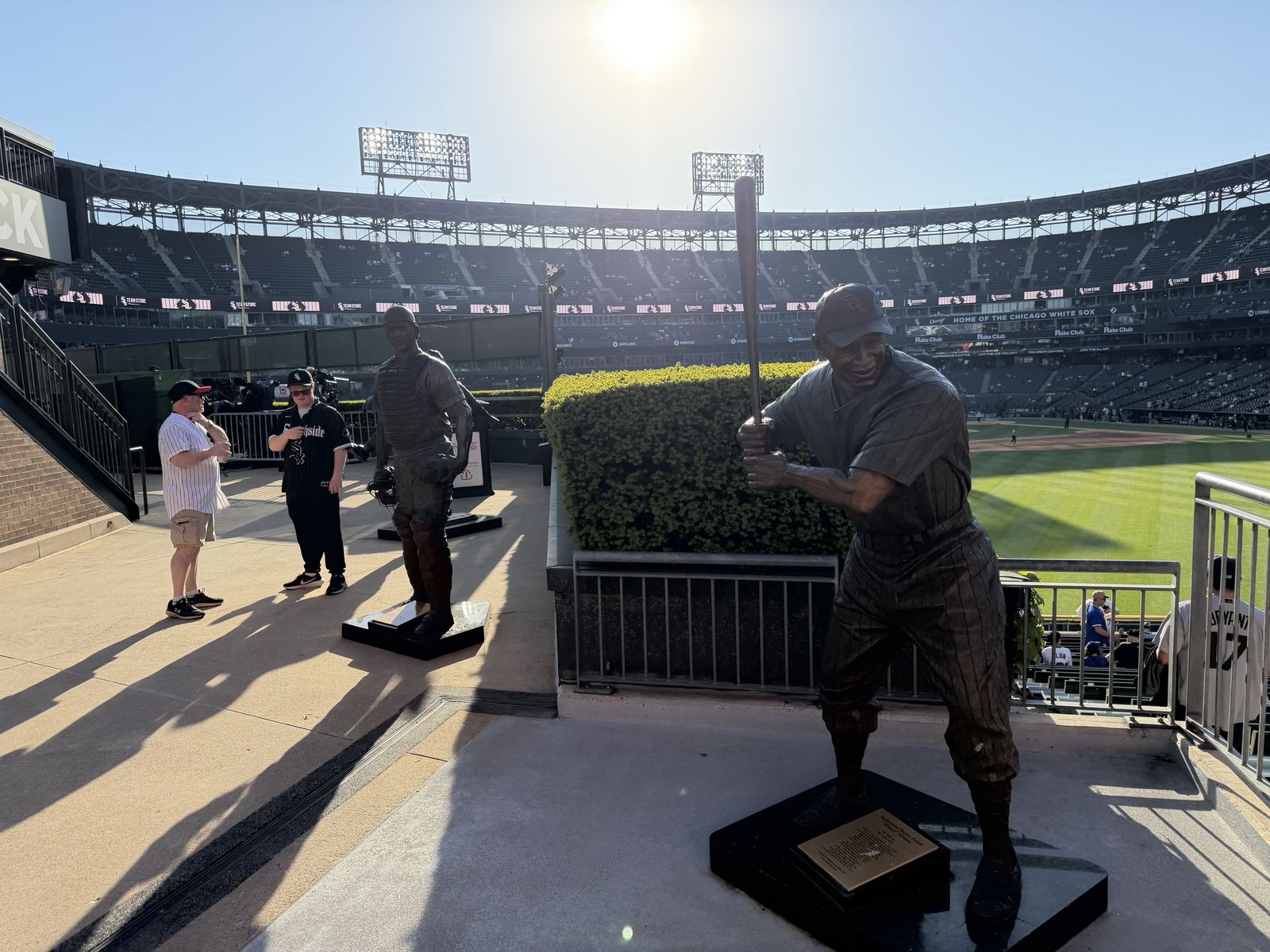
The outfield concourse holds a row of bronze statues honoring the franchise’s greats, and it is one of the better free things to do before a game. The current group includes Minnie Miñoso (the first Black Latino star in the majors and the man fans call Mr. White Sox), Luis Aparicio, Nellie Fox, Carlton Fisk, Harold Baines, Frank Thomas (unveiled July 31, 2011), Paul Konerko, Billy Pierce, and Mark Buehrle. The statues sit on either side of the Fan Deck, a free and easy walk for any fan, and a good one for families killing time before first pitch.
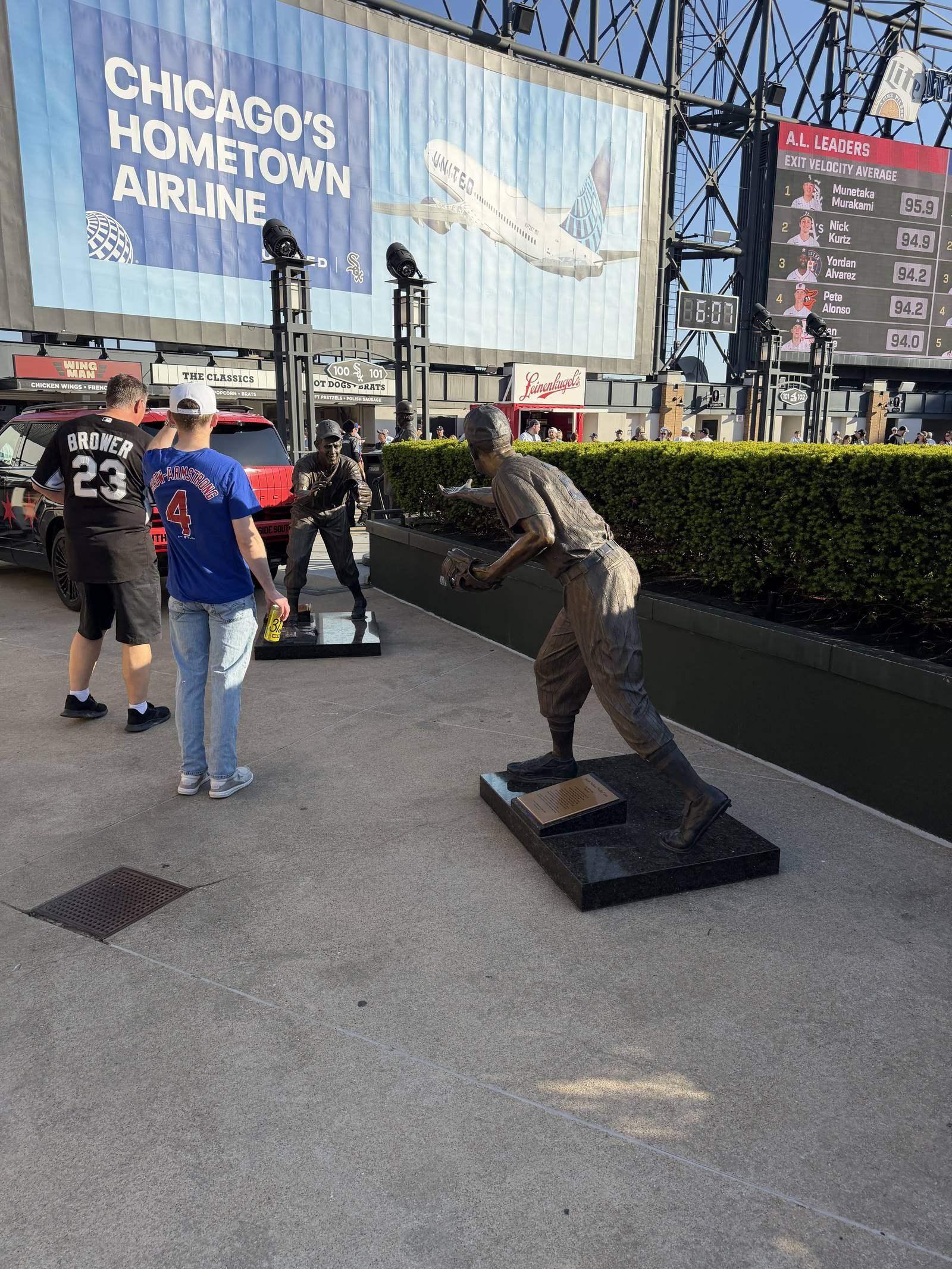
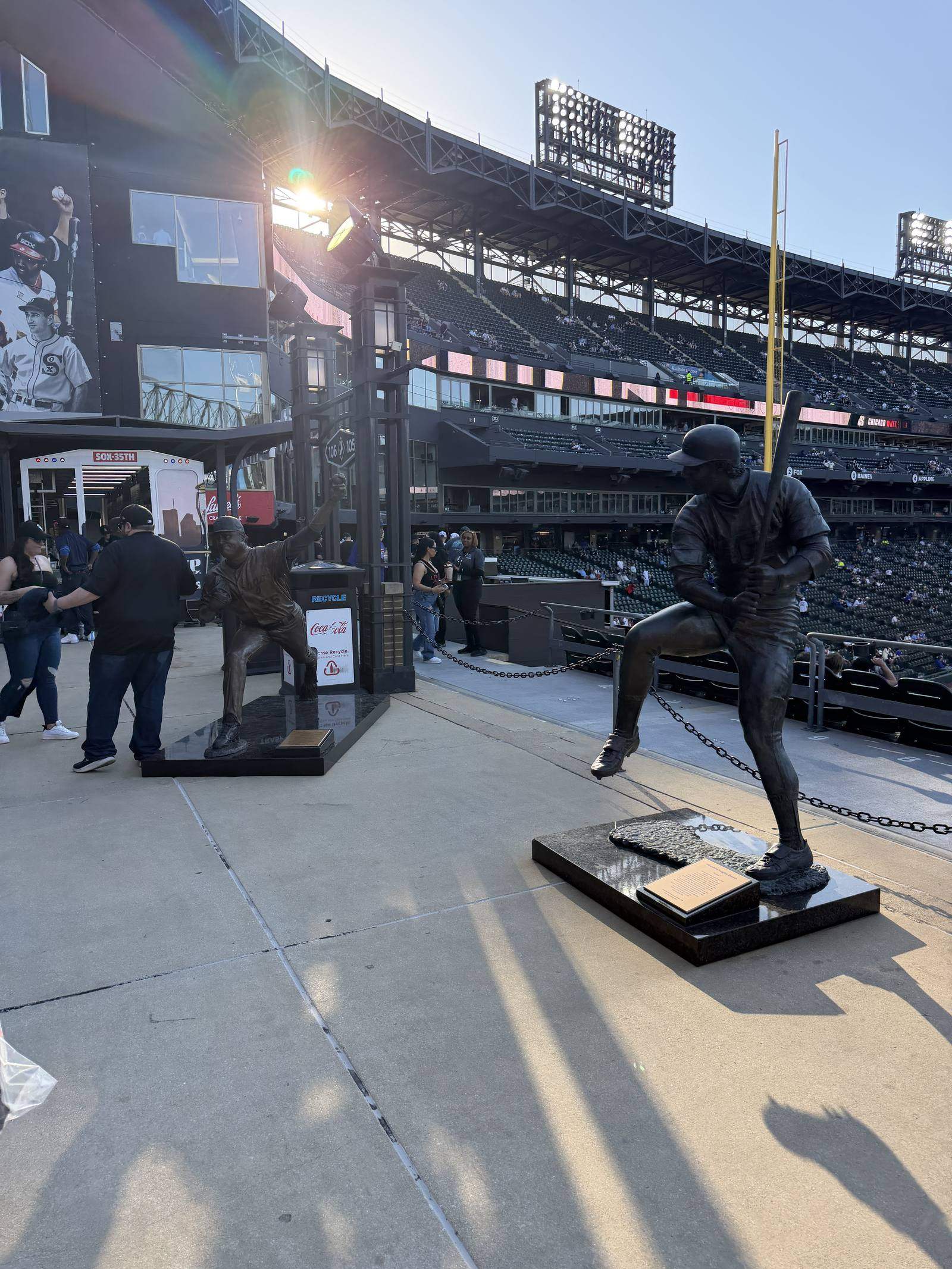
The old Comiskey home plate marker
The diamond at old Comiskey did not vanish when the wrecking ball came. A marble marker set into the sidewalk in the parking lot just north of the current park (Lot B) marks the exact spot where home plate sat from 1910 to 1990. The old foul lines are painted across the lot surface. By measurements that circulate online, old home plate sits roughly 503 feet due north of the current one. It is a sub-five-minute walk and a real photo spot for anyone who cares about where the game has been.
Why this history still matters
The White Sox are the South Side’s team, and that identity runs deep. The fan base is working class and diverse, with strong Latino and Black roots that mirror the neighborhoods around the park, and it carries a chip about playing second fiddle to the Cubs in the national conversation. The deep past is here too: the 1906 “Hitless Wonders” beat the Cubs in the World Series, the 1917 team won it all, and the 2021 club took a division title before the rebuild that followed. Movies, cable news, and podcasts tend to flatten the South Side into a single stale image. The park, and the century of baseball behind it, tells a fuller story.