Getting to Rogers Centre
The quick read
Rogers Centre sits right next to Union Station, Toronto’s main transit hub, and that one fact should shape your whole plan. The subway, the regional GO trains, and the airport train all funnel into Union, and from there it is a short covered walk to the gates. So we lead with transit here, which we don’t do at most parks. In a dense downtown like this, the trains win.
The order: Union Station first, because the TTC subway, GO Transit, and the UP Express from the airport all land you a few minutes from your seat. Then rideshare, for the nights the trains don’t line up with where you’re staying. Then driving and parking, which is a real option but the expensive, slower one downtown, since there is no stadium lot and you’re paying city-garage rates either way.
One more thing, because this park is across an international border for most readers: you need a passport, your money is in Canadian dollars, and your US phone plan may charge you for data the second you land. More on all three below.
Fares, parking rates, and gate times shift year to year, and they’re in Canadian dollars. Give anything time-sensitive below a quick check against the Blue Jays’ official site before you build a plan around it.
Check your own trip in the maps app
Type “Rogers Centre” into Apple Maps or Google Maps, set your hotel as the start, and toggle through the modes: transit, rideshare, drive. Both apps have the TTC and GO schedules built in, so they’ll give you the real time and cost for each option from your exact starting point.
Here’s why that beats any guide: the trains are the answer from almost anywhere downtown, but the right line and whether you transfer depends on where you start. From a hotel near Union it’s a five-minute walk and you skip transit entirely. From up the Line 1 corridor it’s one subway ride. From the suburbs the GO train is cleaner. Let the app sort your specific case, then use the sections below for the detail.
Union Station
This is the part that makes Rogers Centre easy, and it’s why we put it first. Union Station is Toronto’s central transit hub, and it’s right next to the ballpark. Three separate systems run through it, and all three drop you a short covered walk from the gates.
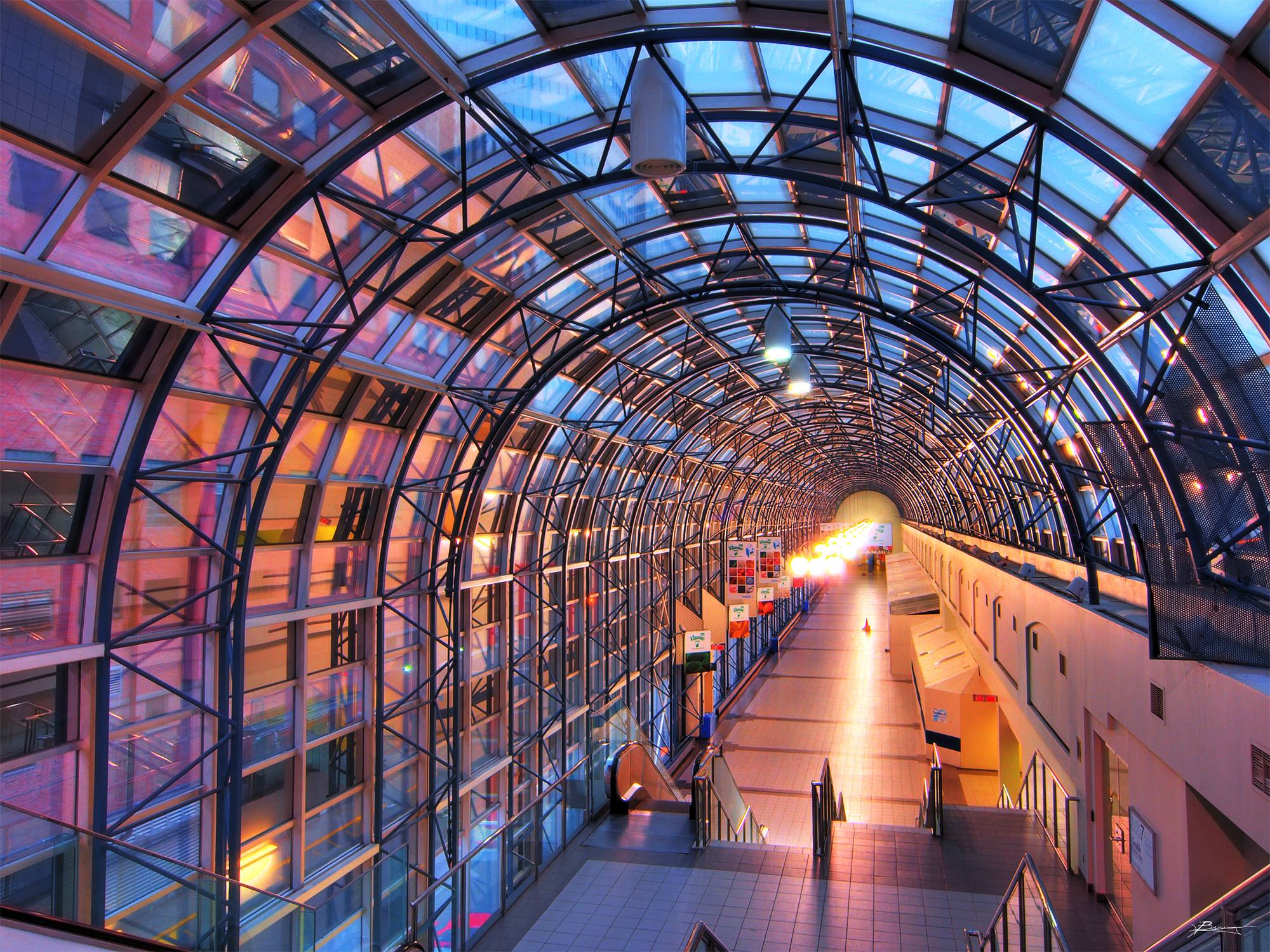
That covered walk matters in a city with Toronto winters and the odd summer downpour. The SkyWalk, an enclosed weatherproof walkway about 160 metres long, connects Union Station straight to the park, and the underground PATH network (Toronto’s downtown pedestrian tunnel system) ties in too. Either way it’s a sheltered stroll, commonly cited around 10 to 15 minutes, and you never need an umbrella.
The TTC subway
The TTC (Toronto Transit Commission) runs the city’s subway, streetcars, and buses. Line 1, the yellow line, stops at Union and at St. Andrew, both a short walk from the park. From most of downtown and a long stretch of the city, a single TTC fare is your simplest way in. A one-way adult fare is $3.30 CAD and includes a two-hour transfer, and you pay it by tapping a contactless credit card, phone, or PRESTO card at the gate.
GO Transit
GO Transit is the regional commuter rail and bus network for the Greater Toronto Area, run by Metrolinx (the provincial agency over GO and the UP Express). GO trains and buses run into Union from across the region, with extra game-day service for Blue Jays games. If you’re staying in the suburbs or coming in from a surrounding city, GO into Union is the clean way to do it without driving downtown.
The UP Express from the airport
The UP Express (the Union Pearson Express, also a Metrolinx line) connects Toronto Pearson International Airport (YYZ) straight to Union Station. Trains leave about every 15 minutes, the trip runs about 25 minutes, and a one-way adult fare is $12.35 CAD, or $9.25 if you tap a PRESTO card. For a fly-in fan it’s the easiest airport-to-downtown link in baseball, and it puts you a covered walk from your seat without a rental car or a cab fare.
When the trains are the right call
- Your hotel is near Union Station or anywhere along the Line 1 subway corridor.
- You’re coming in from the suburbs or a surrounding city where GO runs direct to Union.
- You’re flying into Pearson and would rather take the UP Express than rent a car.
- You want to skip parking and the slow crawl out of downtown garages after the last out.
Rideshare
If the trains don’t line up cleanly from where you’re staying, rideshare is the next call. Uber and Lyft both run in downtown Toronto and drop near the park. The appeal is the usual one: you skip the parking math and the garage exit.
The ride in is simple. The ride home is the part that catches people. When the park lets out at once, the apps surge for the first stretch after the final out, and downtown traffic doesn’t help. Walking a few blocks away from the stadium before you request usually gets you a faster pickup and a lower fare than standing at the gates with everyone else. One honest note: from most of the city, the TTC or GO into Union still beats rideshare on a busy night, so if you came by train, the train is probably your fastest way out too.
Driving and parking
Driving works, and for a few fans it’s the right answer. But at Rogers Centre it’s the expensive, slower option, and we’ll be straight about that. There’s no dedicated stadium lot, so you’re parking in city lots or private downtown garages at downtown prices, then sitting in the same exit traffic as everyone else. Driving makes the most sense for a group of three or more where the per-person fares add up, for anyone already in a rental car for the rest of a Toronto trip, or if you’re coming from somewhere transit doesn’t reach well.
A few things to know.
- The closest options are Green P municipal lots and private garages. Green P is the City of Toronto’s public parking, with lots near the park on streets like Rees Street and Bremner Boulevard, plus private garages throughout the Entertainment District. Game-day rates run roughly $20 to $45 CAD depending on the lot and the date.
- Parking farther out and walking in saves money. On a busy night you can knock $15 to $20 CAD off by parking a few blocks away and walking the rest. The post-2025 marquee weekends are when the close-in lots fill and prices climb.
- Book ahead for the high-demand dates. With the Blue Jays a hot ticket after the 2025 World Series run, the lots near the park sell out for the big games. Prepaying a spot beats circling downtown looking for one.
SpotHero for a spot in advance
For a spot reserved ahead of time, SpotHero is the cleanest option for Rogers Centre parking. SpotHero is a parking-reservation app: you book a downtown lot in advance, prepay in the app, and drive straight to it on game day. Prices climb on higher-demand dates, the post-2025 marquee weekends especially, so check live and book early.
How it works:
- Open the SpotHero app or the Rogers Centre parking page.
- Enter your game date and time.
- Filter by walking distance, price, or covered versus open.
- Reserve and pay in the app.
- Show the digital pass at the lot entrance.
When driving is the right call
- You’re a group of three or more, where the parking cost beats per-person train fares.
- You’re staying somewhere the TTC and GO don’t reach well.
- You want full flexibility on when you leave, and you’re fine with the downtown exit traffic as the price of it.
- You already have a rental car for the rest of your Toronto trip.
From the airport
Two airports serve Toronto, and the right one depends on your carrier. Toronto Pearson (YYZ) is the main one, way out northwest of downtown, and the cleanest link in is the UP Express train: about 25 minutes to Union Station for around $12.35 CAD, then the covered walk to the gates. With bags, that beats fighting downtown traffic in a cab.
Billy Bishop Toronto City Airport (YTZ) sits on the Toronto Islands right off downtown and is much closer in, but only a limited set of carriers fly there. If your flight lands at Billy Bishop, you’re a short ferry or tunnel walk and a quick ride from the park.
Crossing into Canada
For most readers, getting to Rogers Centre means crossing an international border, so a few practical things that don’t come up at the other parks.
- You need a passport. US citizens need a valid passport (or an accepted equivalent like a NEXUS card) to enter Canada and to get back into the US. If you’re driving across the border, expect variable waits at the crossing, sometimes long ones on a busy day. If you’re flying, you clear Canadian customs on arrival; an advance declaration option can speed that up.
- Your money is in Canadian dollars. Prices at the park, the lots, and the trains are all in CAD. Cards work nearly everywhere, but budget and tip in Canadian dollars and check your card’s foreign-transaction fee before the trip.
- Your US phone plan may charge for Canada. Plenty of US carriers bill extra for data and calls north of the border. Check your plan before you land, or set up a local or eSIM data option so your maps app works the moment you step off the plane.
Gates and getting in
Go to whichever gate is closest to where you arrived. If you came in through Union Station on the SkyWalk or the PATH, head for the gate that walkway feeds into. If you parked or got dropped on a particular side, use the nearest gate on that side. There’s rarely a reason to hike around the building for a different entrance.
Gates open 90 minutes before first pitch for a weeknight game and two hours before for a weekend home game.
One Rogers Centre wrinkle worth knowing before you plan your arrival: the roof. The Blue Jays decide game by game whether to play with it open or closed, so a game here is never rained out. If the roof is open it’s an open-air ballpark with real sun and shade in play; if it’s closed, you’re in a climate-controlled building no matter the weather outside. It doesn’t change which gate you use, but it changes what to expect when you walk in.
Accessibility
See something out of date at Rogers Centre, or know it better than we do? Tell us.