Getting to Yankee Stadium
The quick read
Yankee Stadium is one of the easiest parks in baseball to reach without a car. Two separate rail systems stop within a couple of blocks of the gates, and on a game night the trains will get you in and back out faster than any car. So we are leading with them, which is not our usual order.
Trains first. The 4 train drops you at an elevated station right on River Ave, steps from the ballpark, and Metro-North trains pull in three blocks away at Yankees-E. 153rd St. Rideshare second, for when the trains do not line up cleanly from where you are staying. Driving and parking last, because at the gates of a stadium in the South Bronx it is the expensive, slow option, and we will be straight about that below.
One move beats reading any of this: drop “Yankee Stadium” into your maps app with your hotel as the start and toggle through transit, rideshare, and drive. It pulls the live MTA and Metro-North schedules and gives you the real time and cost from your exact starting point in about fifteen seconds.
Subway and railroad fares, parking rates, and gate times shift year to year. Give anything time-sensitive below a quick check against mlb.com/yankees or mta.info before you build a plan around it.
Check your own trip in the maps app
Before you read another word, type “Yankee Stadium” into Apple Maps or Google Maps, set your hotel as the start, and switch through the modes: transit, rideshare, drive. The apps have the subway and Metro-North schedules built in, so they will tell you the real time and cost for each option from your exact starting point.
Here is why it matters. The 4 train is the answer from most of the East Side of Manhattan, but the right line and whether you have a transfer depends on where you start. From near a 4-train stop it is a one-seat ride. From Westchester or Connecticut, Metro-North might be cleaner. From farther out with a group, a rideshare or the lot might win. Let the app sort it for your case, then use the sections below for the detail.
The trains
This is the part that makes Yankee Stadium easy, and it is why we lead with it. Two separate rail systems stop within a short walk of the gates.
The subway
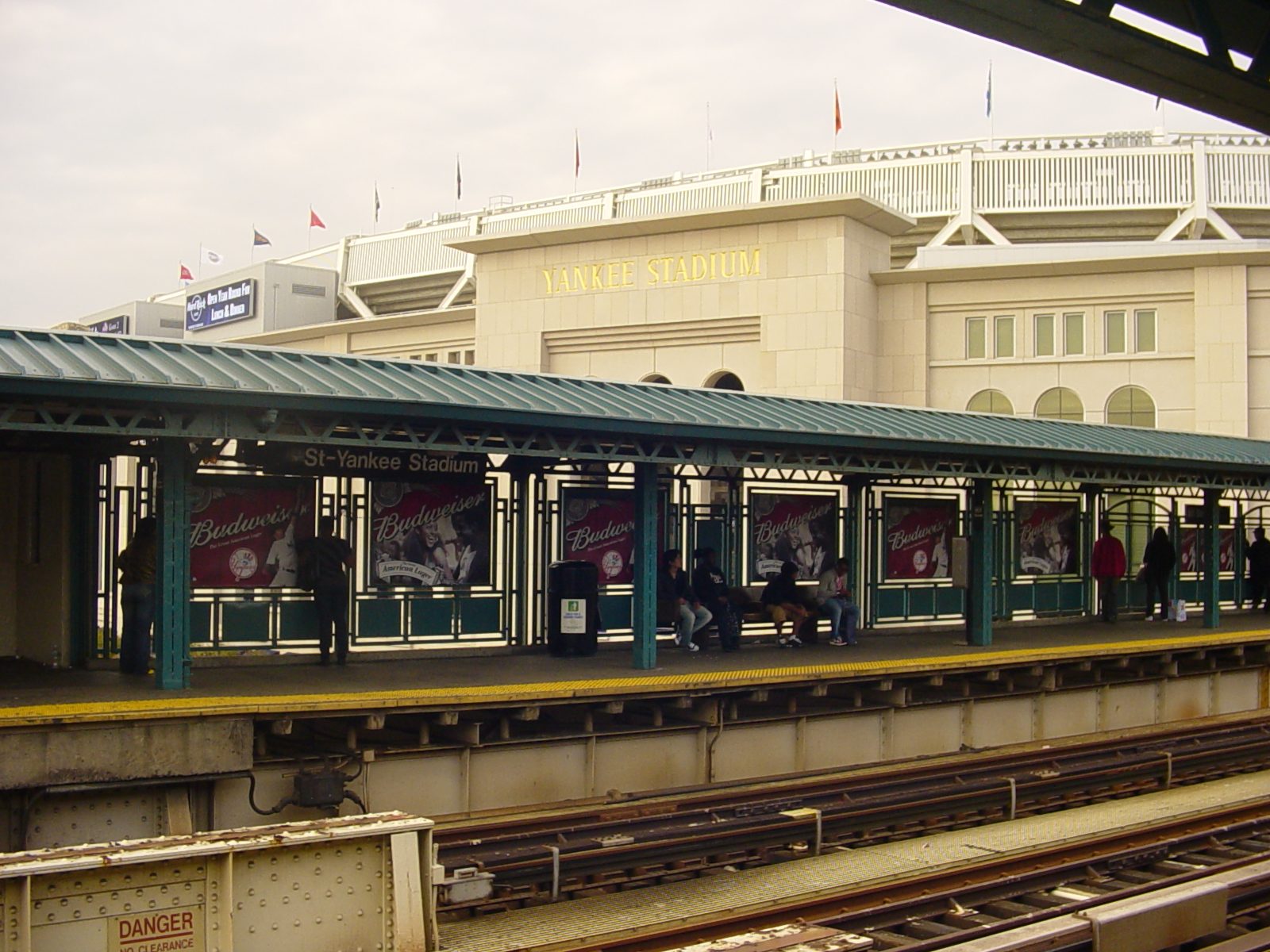
The MTA subway drops you right at 161 St-Yankee Stadium, an elevated station on River Ave at the edge of the park. The MTA is the Metropolitan Transportation Authority, the agency that runs New York’s subways, buses, and commuter rail.
The 4 train (the Lexington Ave express in Manhattan) serves the station at all times, so it is the reliable default no matter when your game starts. The D train serves it at all times except peak-direction rush hours, though it runs to the stadium for games. The B train runs weekday rush hours and middays. A single subway ride is about $2.90, paid by tapping a card or phone at the turnstile with OMNY (the MTA’s tap-to-pay system, short for One Metro New York) or with a MetroCard. For most visitors coming from Manhattan, the 4 is the move.
Metro-North
Metro-North Railroad is the commuter rail that runs north out of the city to the suburbs and the Hudson Valley. Its Hudson Line stops at Yankees-E. 153rd St, three blocks from the park and about 15 minutes from Grand Central Terminal.
For all evening and weekend home games, Metro-North runs special game-day “Yankee Clipper” trains: one-seat rides straight to Yankees-E. 153rd St from the Harlem and New Haven lines, so fans from Westchester and Connecticut do not have to change trains in the city. If you are coming from north of the Bronx, or staying near Grand Central, this is often the cleanest way in.
When the trains are the right call
- Your hotel is a short walk from a 4-train stop, especially along the Lexington Ave line in Manhattan.
- You are coming from Westchester or Connecticut, or staying near Grand Central, where Metro-North runs direct on game days.
- You want to skip parking and beat the post-game crawl out of the lots.
- You are flying in and would rather not deal with a rental car in the city.
Rideshare
If the trains do not line up cleanly from where you are staying, rideshare is the next call. Uber and Lyft work fine for the ride in. The honest catch here is the South Bronx around the park: game-day traffic is real, and getting a car back out after the final out is slow.
The ride in is straightforward. The ride home is the part that catches people. When the park empties at once, the apps surge for the first stretch after the game, and the streets around the stadium clog. Two fixes: set your pickup pin a few blocks away from the immediate gate crush before you request, and give the surge a little time to fall off. You will usually get a faster pickup and a lower fare than standing right at the gates with everyone else. One honest note for Yankee Stadium: on a big night the 4 train usually beats the rideshare out of the Bronx anyway, so if you came by train, the train is probably still your fastest way home.
Driving and parking
Driving is a real option, but at Yankee Stadium it is the expensive, slower one, and we will not pretend otherwise. The trains drop you at the gate for a couple of dollars; the official lots run real money and put you in a post-game crawl through the South Bronx. Driving makes the most sense for a group coming in from outside the city, for anyone already in a rental car for the rest of a New York trip, or if you are staying somewhere the trains do not reach well. Go in knowing transit is the better answer here.
A few things to know.
- The official prepaid lots and garages run about $49 to self-park. The main ones are the Gerard Ave Lot, the River Ave Garage, and the Ruppert Plaza Garage.
- Third-party lots and garages run cheaper, roughly $9 to $33. You book these ahead through a parking app rather than at the gate.
- Lots open about two to three hours before first pitch.
SpotHero for a spot in advance
For a spot reserved ahead of time, SpotHero is the cleanest option for Yankee Stadium parking. SpotHero is a parking-reservation app: you book a lot in advance, prepay in the app, and drive straight to it on game day. Prices climb on higher-demand dates, the Subway Series and the Red Sox especially, so check live and book early.
How it works:
- Open the SpotHero app or the Yankee Stadium parking page.
- Enter your game date and time.
- Filter by walking distance, price, or covered versus open.
- Reserve and pay in the app.
- Show the digital pass at the lot entrance.
When driving is the right call
- You are a group of three or more, where the parking cost beats per-person train fares.
- You are coming from outside the city and the trains do not reach you well.
- You want full flexibility on when you leave after the game, and you are fine with the lot crawl as the price of it.
- You already have a rental car for the rest of your New York trip.
Gates and getting in
Go to whichever gate is closest to where you arrived. There is rarely a reason to hike around the stadium for a different entrance.
If you came by 4 train or Metro-North, the closest is Gate 4 (Home Plate), the main gate, which feeds into the Great Hall, the long entry concourse hung with banners of Yankee legends. The others ring the park: Gate 2 (Left Field), Gate 6 (Right Field), which is also the entrance for the New York Yankees Museum off the Great Hall, and Gate 8 (Center Field). If you parked or are coming from a different side, take the gate on that corner.
Gates open 90 minutes before the scheduled start for Yankees home games, with timing subject to change for doubleheaders, Opening Day, and the postseason. If you want to see Monument Park out beyond center field before the game, get in early; it closes to fans 45 minutes before the scheduled start, and the line can close earlier.
See something out of date at Yankee Stadium, or know it better than we do? Tell us.